background of the comic
This comic is a guide that helps in creating alternative text descriptions for individual comic panels or entire comics. The main goal is to optimize existing alt texts for comics. For online comics and social media images, having the alternative text is crucial, as accessibility is the primary concern not perfection. “machine-readable” was first published in German as “maschinen-lesbar” in Genderstudies versus Comicstudies: Schnittmengen von Forschung, Lehre und Praxis – Intersections of Research, Teaching, and Practice at De Gruyter. The German ebook is free to download under the link. Unfortunately the comics in the book are not accompanied by a text-based version. Here however you can find the screen-readable comic version below the visual comic.
visual version of the comic
Transcript of Comic to Plain Text
“machine-readable”
by Illi Anna Heger
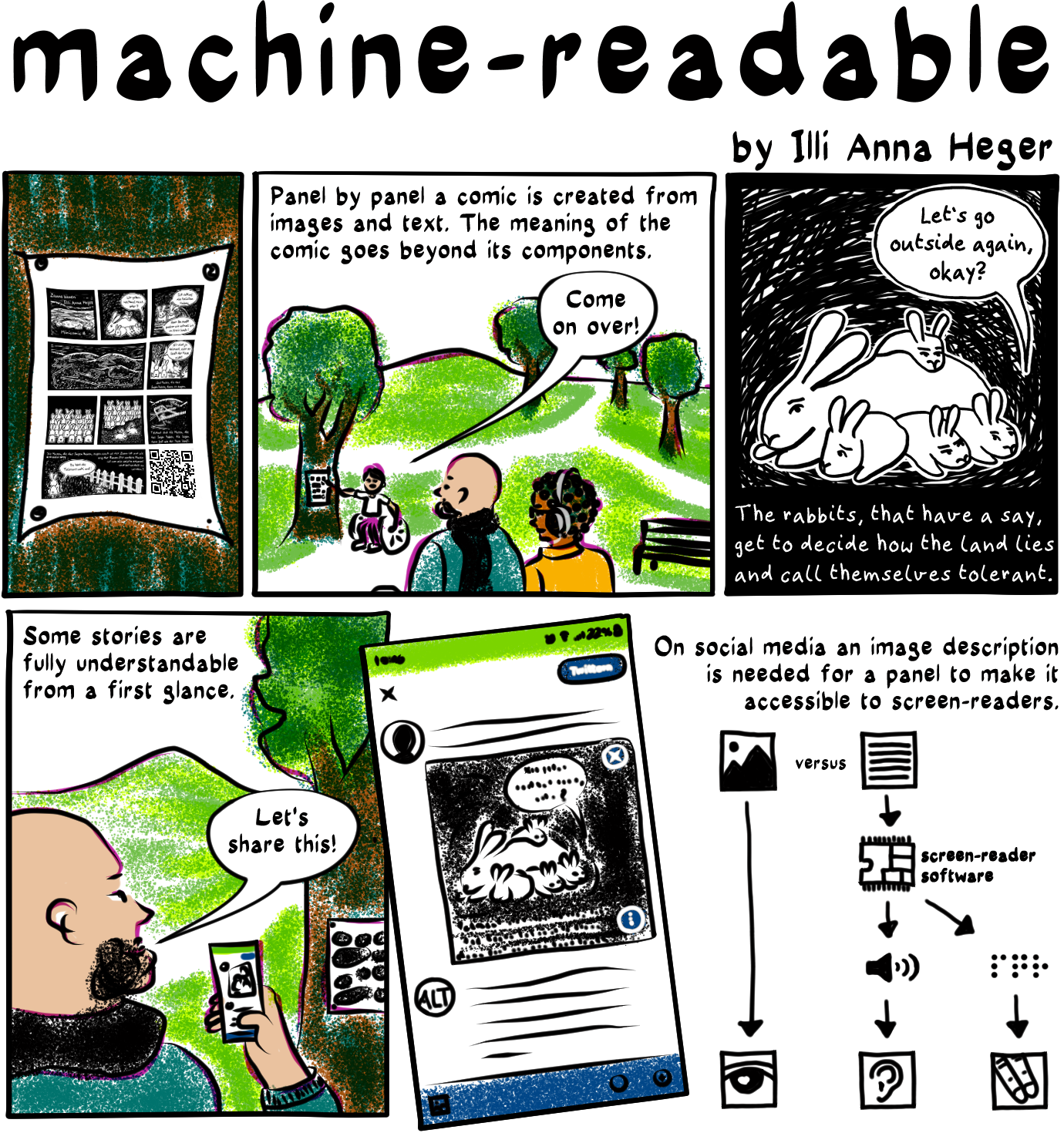
At a tree, a black and white comic page is thumb-tacked to the trunk. A person with pink pants, short hair in a modern wheel chair found it and calls two other people: “Come on over!” Both of approach, one bald with a full beard and the other with big headphones and a yellow coat. Around them a public park with rolling hills, trees and benches to relax on.
Text: Panel by panel a comic is created from images and text. The meaning of the comic goes beyond its components.
A single panel of that comic page shows a rabbit burrow with four little white rabbits huddled up to a adult one. One of the little ones says to another: “Let’s go outside again, okay?”
Below in rounded handwriting: The rabbits, that have a say, get to decide how the land lies and call themselves tolerant.
Text in a new panel: Some stories are fully understandable from a first glance.
The bald white person takes a picture with their phone, writes in their social media app and says: “Let’s
share this!” Zooming in on their phone screen, hints of text, the picture with the rabbit and below the word “ALT” with more text indicated as lines next to it.
Text: On social media an image description is needed for a panel to make it accessible to screen-readers.
In the diagram below: Various icons are connected via arrows. An icon depicting mountains and a sun stands for visual image, is next to an icon with five straight lines on top of each other stands for test. Between them the word versus. From the icon for visual image a direct arrow goes to an icon with an eye, that stands for visual reading. From the text icon a direct arrow goes to the icon for screen-reader-software, it looks like a piece of circuit board. From there two arrows, one leads to the icon of a loud speaker and on the the icon of an ear, for acoustic reading and the second leads to an icon with three Braille characters (the letter p, q, and r) and from there to an icon with two fingers, that stand for haptic reading.
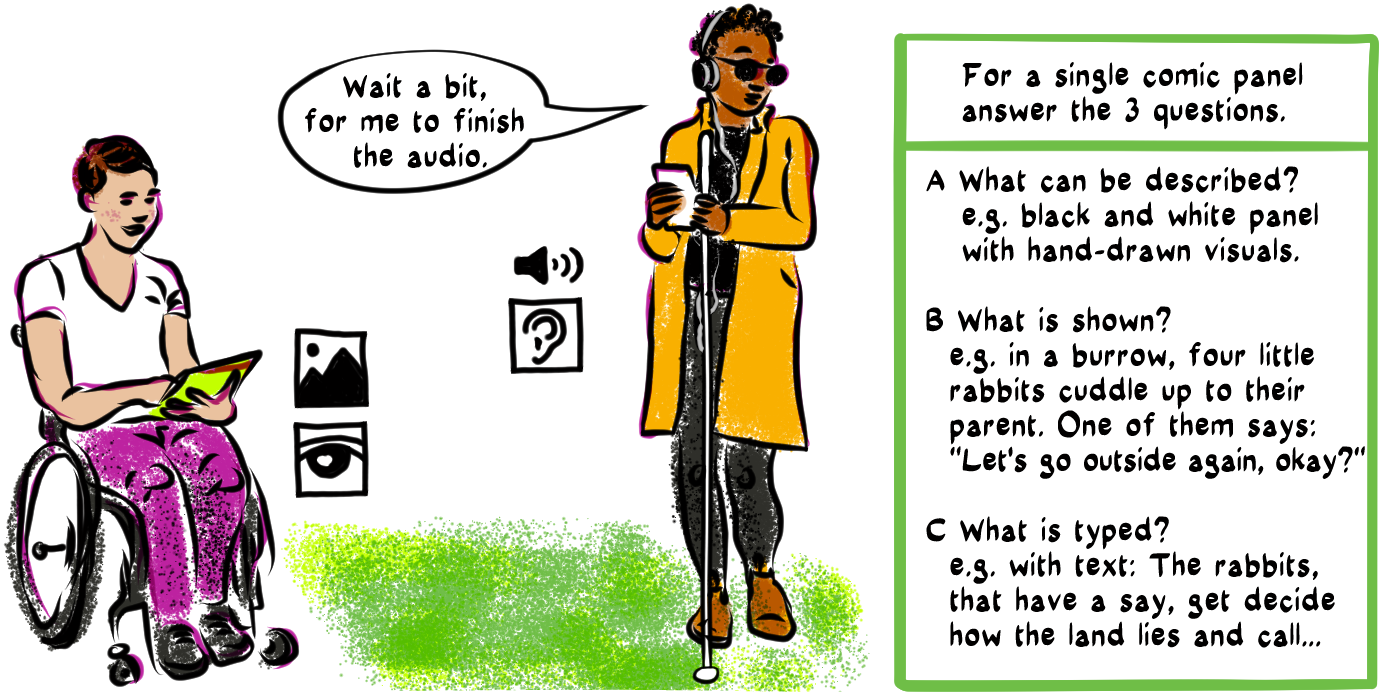
The person with the pink pants is white, they scroll and read on their tablet. Next to them the icon for visual image and for visual reading.
The person with the yellow coat is Black, their hair is done up in Bantu knots. They still wear their over-ear headphones and hold a mobile phone in their hands. They hold their white stick in front of them and call over: “Wait a bit, for me to finish the audio.” Next to them the icons for loud speaker and acoustic reading.
In a green frame instructions to create alternative texts for images: For a single comic panel answer the 3 questions.
A What can be described? e.g. black and white panel with hand-drawn visuals.
B What is shown? e.g. in a burrow, four little rabbits cuddle up to their parent. One of them says: “Let’s go outside again, okay?”
C What is typed? e.g. with text: The rabbits, that have a say, get decide how the land lies and call…
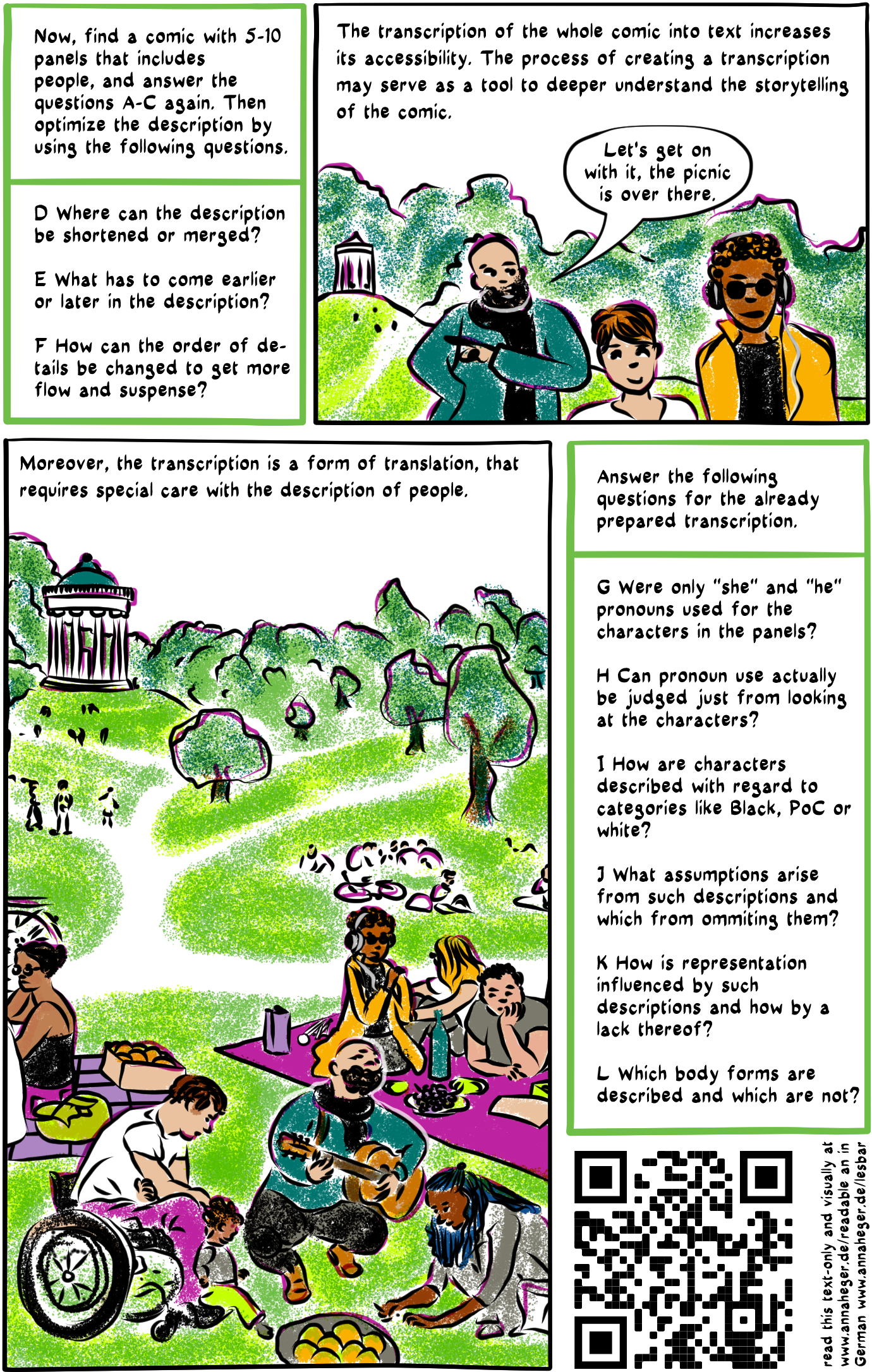
In another green frame below: Now, find a comic with 5-10 panels that includes people, and answer the questions A-C again. Then optimize the description by using the following questions.
D Where can the description be shortened or merged?
E What has to come earlier or later in the description?
F How can the order of details be changed to get more flow and suspense?
Text: The transcription of the whole comic into text increases its accessibility. The process of creating a transcription may serve as a tool to deeper understand the storytelling of the comic.
The three stand close together now. The bearded one with his turquoise sweater and long black scarf points to the left and says: “Let’s get on with it, the picnic is over there.” In the background trees and very small on a hill the Munich Monopteros, Im Hintergrund Bäume und klein auf einem Hügel der Münchner Monopteros, a round temple with columns in the Greek style.
Text: Moreover, the transcription is a form of translation, that requires special care with the description of people.
The three are now at the big picnic close to the Monopteros. Groups of other people sit on the grass in some distance. The person in the yellow coat eats grapes on a pink blanket her white stick folded up next to them. There are more people on the blanket and they are all surrounded by food and drinks. The bearded one holds the guitar pressed against their soft belly while playing and singing. A child has climbed up on the foot rest of the wheel-chair and the person with the pink pants talks to the kid. A person with a gray flowing dress is watching them. They are Black with long box braided hair.
Another green frame: Answer the following questions for the already prepared transcription.
G Were only “she” and “he” pronouns used for the characters in the panels?
H Can pronoun use actually be judged just from looking at the characters?
I How are characters described with regard to categories like Black, PoC or white?
J What assumptions arise from such descriptions and which from omitting them?
K How is representation influenced by such descriptions and how by a lack thereof?
L Which body forms are described and which are not?
Next to a QR code to the online Version of the comic, the text: text based oder visually readable: dt. www.annaheger.de/lesbar and en. www.annaheger.de/readable